SANGRE DE DRAGO


Botanical name:
Croton lechleri, Croton palanostigma (also called Croton benthamianus)
Alternative names:
Sangre de grado, Sangre de grada
Main indications:
cancers
tuberculosis
mouth ulcers
eczema
periodontal disease
skin injuries, insect bites
flu, colds
rheumatism
Short characteristics:
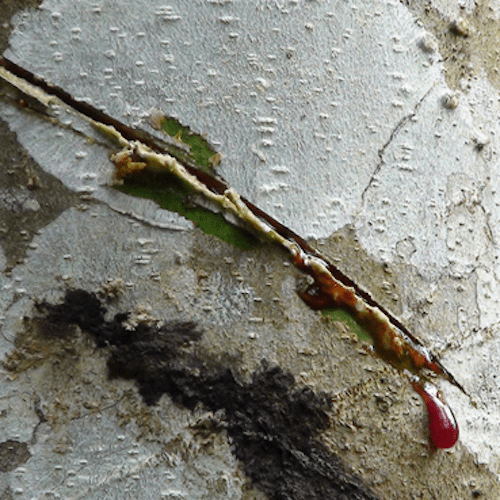
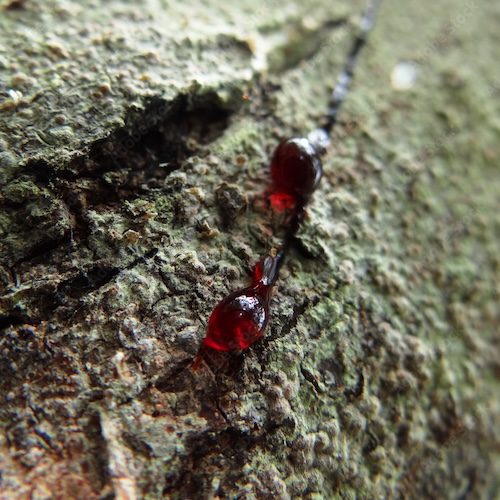
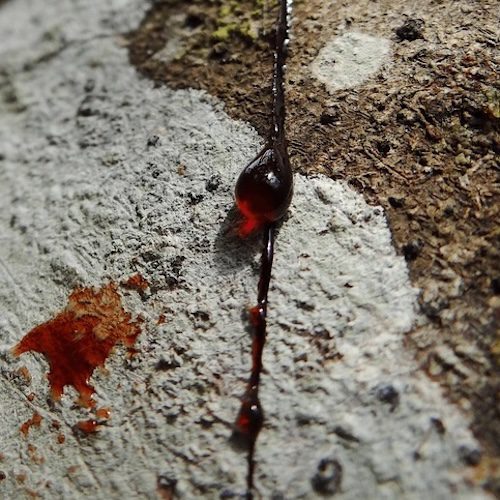
Sangre de Drago, commonly known as “Dragon’s Blood,” is a sacred and highly valued resin from several different trees native to the Amazon rainforest.
This leads to some confusion. Most often, Sangre de Drago means resin from Croton lechleri. This is a tall growing up to 20 meters high. However, resin from other trees is sometimes also called Sangre de Drago in Amazonian region, for example the resin from trees of the Dracaena family. This is the mushroom-like tree which you will find on images when googling “Sangre de Drago”. To make the things more complicated, in Peru the resin is called Sangre de Grado, which is not a typo but simply a local name.
Its remarkable healing properties have been employed for centuries by indigenous peoples across Peru, Brazil, and neighboring regions. Traditionally, the tree’s resin—obtained from incisions in its bark—is used both externally and internally for a wide range of health conditions. Rich in bioactive compounds such as alkaloids, tannins, and phenolic acids, Sangre de Drago exhibits powerful anti-inflammatory, antimicrobial, antiviral, and tissue-regenerating effects. It is renowned for its ability to accelerate wound healing, stop bleeding, and protect damaged tissues from infection. Its internal applications support immune modulation, combat viral infections like hepatitis and herpes, and help treat gastrointestinal issues such as ulcers, diarrhea, and intestinal inflammations. Scientific studies support these traditional uses, demonstrating that compounds like taspine and alkaloids have significant antimicrobial and anti-inflammatory activities, while also promoting tissue regeneration and reducing oxidative stress. The plant’s versatility also extends to preventing arteriosclerosis, supporting heart health, and improving overall immunity. Safe for external use in treating wounds, ulcers, burns, and insect bites, Sangre de Drago is considered an essential herbal remedy to have in every home pharmacy, with its wide-ranging medicinal benefits validated by both tradition and modern science.
The usual way of use:
Oral use: Typically, 15-20 drops of pure, undiluted resin are taken daily, preferably on an empty stomach. The drops should be dissolved in a small amount of water (1-2 tablespoons). This dosage should be reached gradually, starting with three drops on the first day and increasing by two drops each subsequent day.
External use: For mouth rinses and gargles, use a solution of 3-10 drops in a quarter glass of water. Undiluted resin is applied directly to wounds, burns, insect bites, and mouth ulcers.
Composition
The therapeutic effects of Sangre de Drago are primarily attributed to its rich phytochemical profile:
- Taspine: A key alkaloid with potent tissue regenerative properties, known to promote wound healing, stop bleeding, and support tissue repair.
- Alkaloids: The resin contains various alkaloids such as harman, harmine, and harmaline, which contribute to antimicrobial, anti-inflammatory, and neuroprotective effects.
- Proanthocyanidins and flavonoids: These polyphenols provide powerful antioxidant activity, helping neutralize free radicals and prevent oxidative damage.
- Phenolic acids: Including chlorogenic acid, which supports detoxification and reduces inflammation.
- Resins and terpenes: Contributing to antimicrobial activity and tissue healing.
This combination supports the plant’s broad biological actions, especially its capacity to promote tissue regeneration and fight microbial infections.
Traditional Use
For centuries, indigenous tribes in the Amazon have utilized Sangre de Drago for a variety of medicinal purposes:
- Wound healing: The resin is applied topically or used as a poultice to accelerate the healing of cuts, burns, ulcers, and injuries. Its hemostatic properties help control bleeding quickly.
- Treatment of gastrointestinal issues: Decoctions are used to treat stomach ulcers, gastritis, diarrhea, and intestinal inflammations. Its antimicrobial effects support the elimination of pathogenic bacteria, fungi, and parasites.
- Infections: It is employed in the treatment of viral infections like hepatitis B and herpes, leveraging its antiviral properties.
- Inflammation and pain: The plant helps reduce inflammation, swelling, and associated pain, especially in conditions like rheumatism and arthritis.
- Healing of nerve and tissue damage: Traditional knowledge recognizes its ability to promote tissue regeneration, including recovery from injuries and chronic wounds.
- Protection against environmental toxins: The plant’s detoxifying qualities help eliminate harmful substances accumulated from environmental exposure or illness.
In traditional ceremonies, Sangre de Drago is also used for spiritual cleansing and protection, emphasizing its role as a sacred medicine.
Precautions and Possible Interactions with Medicines
Although Sangre de Drago is extensively used traditionally, some precautions are necessary:
- Drug interactions: The plant’s bioactive compounds, especially alkaloids such as harmine, can interfere with pharmaceuticals, notably anticoagulants, anti-inflammatory drugs, and drugs processed by the liver. Caution is advised to prevent interactions that could increase bleeding risks or alter drug efficacy.
- Toxicity concerns: While generally safe when used externally or in traditional doses, high doses or prolonged internal use may cause gastrointestinal issues or liver problems.
- Pregnancy and breastfeeding: Limited safety data are available; pregnant or nursing women should consult healthcare professionals before use.
- Allergic reactions: Possible allergic or skin reactions may occur, especially in sensitive individuals.
Always seek advice from healthcare providers before using Sangre de Drago, especially during ongoing medical treatments or in serious health conditions.
Available Scientific Studies
Recent scientific research supports many of Sangre de Drago’s traditional uses:
**“Review of Sangre de Drago (Croton lechleri) — A South American Tree Sap in the Treatment of Diarrhea, Inflammation, Insect Bites, Viral Infections, and Wounds: Traditional Uses to Clinical Research”**
Author: Kenneth Jones (2003)
Overview: Summarizes both traditional applications and clinical evidence, particularly highlighting treatments for diarrhea, wounds, ulcers, viral infections, and insect bites.
Link: https://pubmed.ncbi.nlm.nih.gov/14736360/ Wikipedia+15PubMed+15Thieme+15ResearchGate**“Efficacy of Dragon’s Blood Cream on Wound Healing: A Randomized, Double-Blind, Placebo-Controlled Clinical Trial”**
Authors: F. Namjoyan et al. (2015)
Overview: Demonstrated that topical application of the resin significantly accelerates wound re-epithelialization, fibroblast migration, and vascular matrix reforming—supporting traditional uses in wound healing.
Link: https://www.ncbi.nlm.nih.gov/pmc/articles/PMC4737969/ PMC+2SpringerLink+2**“SP‑303, an Antiviral Oligomeric Proanthocyanidin from the Latex of Croton lechleri (Sangre de Drago)”**
Authors: R. Ubillas et al. (1994)
Overview: Describes the isolation of SP‑303—a proanthocyanidin fraction with antiviral activity—which later led to the development of crofelemer.
Link: Relevant details available via reference summaryScienceDirect+15ScienceDirect+15Wikipedia+15Wikipedia+3Wikipedia+3Wikipedia+3**“Protective Effects of Croton lechleri Sap on Advanced Glycation Endproducts (AGEs), LDL Oxidation, and Reactive Oxygen Species in Endothelial Cells”**
Author: Z. Chen (2022)
Overview: Shows the resin can reduce albumin glycation, LDL oxidation, and reactive oxygen species in human vascular cells—highlighting its antioxidant and vascular protective properties.
Link: https://www.tandfonline.com/doi/abs/10.1080/14786419.2021.1960520 Taylor & Francis Online+1**“A Review on Phytochemistry and Recent Pharmacology of Dragon’s Blood (Croton lechleri Müll. Arg.)”**
Overview Authors: (published online)
Overview: Highlights primary bioactive constituents—proanthocyanidins, taspine, diterpenoids—and therapeutic properties such as wound healing, anti-inflammatory, antimicrobial, antiviral, antioxidant, and antitumor effects.
Link: https://www.pharmaceuticaljournal.net/archives/2025/vol7issue1/PartC/7-1-30-292.pdfWikipedia+15pharmaceuticaljournal.net+15X-MOL+15**“New Biological Activity of Croton lechleri Twig Extracts Obtained via Green Extraction Techniques”**
Author: A. Tzintzarov (2024)
Overview: Introduces previously underexplored twig extracts of the plant, revealing new biological activities that might broaden therapeutic potential.
Link: https://www.mdpi.com/1420-3049/29/17/4161 MDPI