

AÇAÍ
Botanical name:
Euterpe oleracea Mart.
Alternative names:
Açaí, açaí-do-Pará. Juçara in trade is often Euterpe edulis, a related palm.
Main indications:
food fruit
everyday energy, as food
Short characteristics:
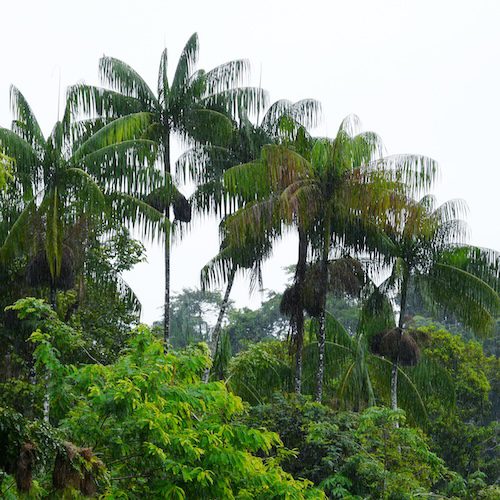
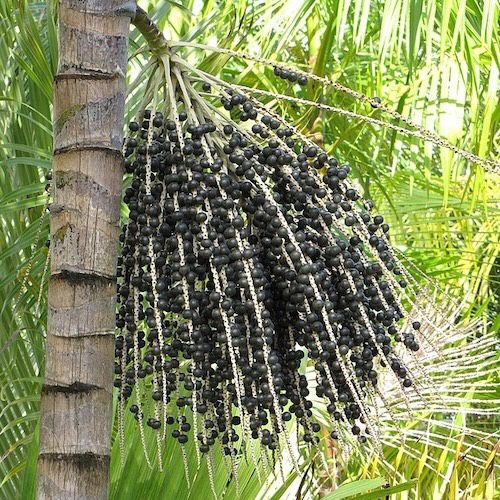
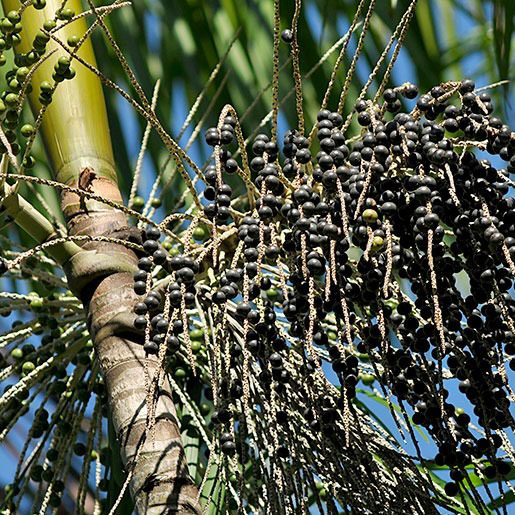
Açaí (Euterpe oleracea) is an Amazonian palm fruit, everyday food along the floodplain — bowls, juice, pulp. People eat it for energy and for the usual antioxidant-food talk. Juçara in the trade is often Euterpe edulis, a related species, not the same palm.
This is fruit, not a fever-parasite medicine, not a liver or yellow-eye drug, not a blood-sugar treatment, and not a cure for kidney trouble, stomach ulcers, or parasites. Treat it as a palm fruit you can eat, not as a clinic protocol.
The usual way of use:
Eat the unsweetened pulp, or drink it without the syrup. The bowl that made the berry famous outside Brazil is often sugar, granola, and a brand. That is dessert. Frozen pulp without added sugar is the food.
Composition
Ripe açaí pulp is fatty for a fruit and dark with anthocyanins. Schauss and colleagues measured cyanidin 3-glucoside and cyanidin 3-rutinoside as the main pigments, plus proanthocyanidins, a little of other flavonoids, and a fatty-acid profile dominated by oleic acid. Resveratrol, when it appears, is a trace — not the point of the palm.
- Anthocyanins: cyanidin glycosides that make the pulp purple-black.
- Oil fraction: oleic-rich, closer to a fatty fruit than to a watery berry.
- Not a vitamin-C bomb: do not steal camu-camu’s story and paste it here.
Traditional Use
On the Amazon estuary the fruit is food: vatapá’s neighbor, the afternoon bowl, the boat breakfast. That is older and more honest than the export “superfood” wave. Energy talk is calories and habit, not a mitochondrial drug.
- Food: pulp, juice, bowls.
- Export myth: weight-loss, detox, anti-aging. The papers do not carry that load.
Precautions and Possible Interactions with Medicines
Food pulp is food. Powders and juices with sugar, or with undeclared fillers, are a different market.
- Sugar-added bowls and juices: the common way to cancel the point.
- Allergy and pollen cross-talk: uncommon but reported with palm fruits.
- Kidney disease / potassium: treat concentrated daily liters as a diet change, not as nothing.
- Drug claims: there is no clinical basis for using açaí as an antimicrobial or antidiabetic drug.
Available Scientific Studies
Two papers that describe the fruit instead of selling it.
“Phytochemical and nutrient composition of the freeze-dried amazonian palm berry, Euterpe oleraceae Mart. (acai)”
Authors: Schauss AG, Wu X, Prior RL, Ou B, Patel D, Huang D, Kababick JP (2006)
Overview: Composition of a standardized freeze-dried pulp/skin powder: anthocyanins, proanthocyanidins, fatty acids (oleic and palmitic dominant), amino acids, sterols. The baseline chemistry paper. Not a disease trial.
Link: https://pubmed.ncbi.nlm.nih.gov/17061839/“Amazon acai: chemistry and biological activities: a review”
Authors: Yamaguchi KK, Pereira LF, Lamarão CV, Lima ES, da Veiga-Junior VF (2015)
Overview: Review of Euterpe chemistry and experimental biological activities. Useful for the compound list and for seeing how far the lab work actually goes — which is not “cures parasites and kidney disease.”
Link: https://pubmed.ncbi.nlm.nih.gov/25722148/