

MARCELA

Botanical name:
Achyrocline satureioides (Lam.) DC.
Alternative names:
Marcela, macela, hembra, marcela del campo
Main indications:
stomach and digestion, in folk use
rest and colds, as a common tea
Short characteristics:
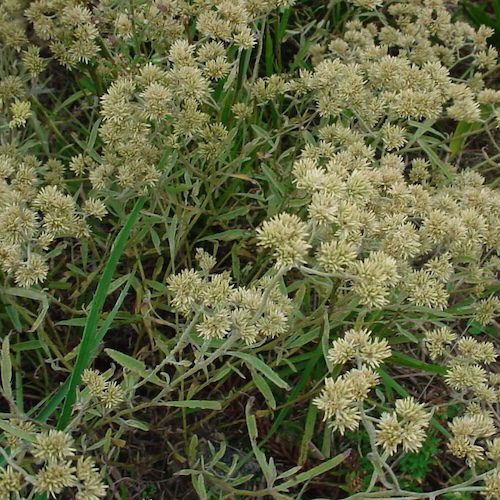
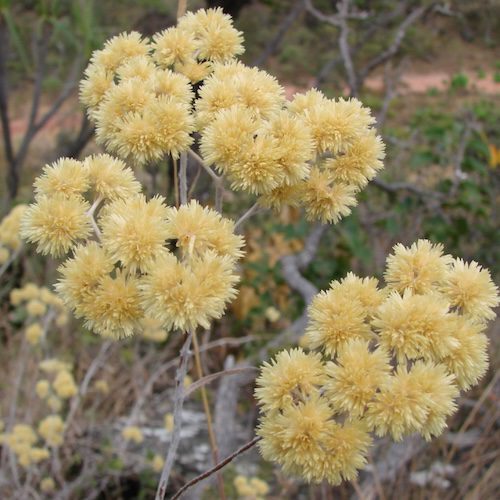
Marcela is Achyrocline satureioides, a South American Asteraceae of grassland and open country in Brazil, Uruguay, Argentina, Paraguay, and neighboring lands. A yellow, woolly flower-head tea. It is not an Amazonian rainforest exclusive.
People drink the inflorescence for stomach, cramps, and rest. Laboratory anti-ulcer and neutrophil papers exist. They do not make marcela a treatment for peptic ulcer disease, flu, or anxiety as diagnoses.
The usual way of use:
Infusion of the flower heads — a mild tea, not a boiled root and not a week-long dieta. That is the folk cup. Alcoholic extracts in papers are a different preparation. Skip “antiviral protocol” bottles.
Composition
The flower heads carry flavonoids that keep getting named: quercetin, luteolin, and 3-O-methylquercetin, free and glycosylated. That is the chemical handle for most of the lab work. Essential-oil traces and other phenolics sit around them.
- Quercetin, luteolin, 3-O-methylquercetin: the marker flavonoids of the heads.
- Not a single-molecule drug: teas are mixed, weak, and variable.
Traditional Use
In southern South America the infusion is a household tea for digestion, cramps, and “the nerves,” and for colds. That is popular medicine of the pampa and the south, not a Shipibo master plant. If a shop files it under Amazonian shamanism, the shop is lost.
- Stomach tea: dyspepsia, cramps, after heavy food.
- Colds and rest: folk, not virology clinic.
Precautions and Possible Interactions with Medicines
Aqueous teas have a long household record. That is not the same as a clean human safety file for extracts.
- Asteraceae allergy: possible.
- Ulcer disease: a rat paper is not omeprazole. Get diagnosed.
- Pregnancy: no solid data; skip strong extracts.
- Sedatives: a “calm the nerves” tea is still a habit to stack carefully.
Available Scientific Studies
Two experimental papers on the right plant. Both are animal or cell work.
“Antiulcer effects of Achyrocline satureoides (Lam.) DC (Asteraceae) (Marcela), a folk medicine plant, in different experimental models”
Authors: Santin JR, Lemos M, Klein Júnior LC, Niero R, de Andrade SF (2010)
Overview: Hydroalcoholic inflorescence extract reduced lesion index in rodent ulcer models and increased mucus; gastric acid secretion did not change. Animal pharmacology. Not a human ulcer trial.
Link: https://pubmed.ncbi.nlm.nih.gov/20546870/“Achyrocline satureioides (Lam.) D.C. Hydroalcoholic Extract Inhibits Neutrophil Functions Related to Innate Host Defense”
Authors: Barioni ED, Santin JR, Machado ID, Rodrigues SF, Ferraz-de-Paula V, Wagner TM, Cogliati B, Corrêa Dos Santos M, Machado Mda S, de Andrade SF, Niero R, Farsky SH (2013)
Overview: Extract reduced LPS-driven neutrophil migration in rats and damped oxidative burst, with quercetin and luteolin confirmed in the extract. Immunology in animals. Not an anti-inflammatory prescription.
Link: https://pmc.ncbi.nlm.nih.gov/articles/PMC3582058/